


Page 29 - october22_previewaa.indd
P. 29
TAP TIMES       -29-                                OCTOBER 2022


           Battery discovery at Argonne                         What’s more, when cycled at high volt-
             could impact grid, vehicles                        age (4.5 volts), a sodium-ion battery can
                                                                greatly increase the amount of energy that
        LEMONT, Ill. — Researchers at Ar-                       can be stored in a given weight or volume.
        gonne National Laboratories have un-
        covered new avenues for overcoming                      Performance decline
        the performance decline that occurs                     However, its fairly rapid performance de-
        with repeated charge-discharge cy-                      cline with charge-discharge cycling has
        cling in the cathodes of next genera-                   stymied commercialization.
        tion batteries.
                                                                Researchers at the U.S. Department of En-
        Greater-range needed                                    ergy’s (DOE) Argonne National Laboratory
        Battery-powered vehicles have made a                    have discovered a key reason for the per-
        signifi cant dent in the transportation mar-             formance degradation: the occurrence of
        ket. But that market still needs lower                  defects in the atomic structure that form
        cost batteries that can power vehicles for              during the steps involved in preparing the
        greater ranges.                                         cathode material.

        Also desirable are low-cost batteries able              Structural earthquake in the cathode
        to store on the grid the intermittent clean             These defects eventually lead to a struc-
        energy from solar and wind technolo-                    tural earthquake in the cathode, resulting
                                                                in catastrophic performance decline during
        gies and power hundreds of thousands of                 battery cycling. Armed with this knowl-
        homes.                                                  edge, battery developers will now be able

                                                                to adjust synthesis conditions to fabricate
                                                                far superior sodium-ion cathodes.


                                                                Key to making this discovery was the
                                                                team’s reliance on the world-class sci-
                                                                entifi c capabilities available at Argonne’s
                                                                Center for Nanoscale Materials (CNM) and
                                                                Advanced Photon Source (APS), both of
                                                                which are DOE Offi  ce of Science user facili-
                                                                ties.
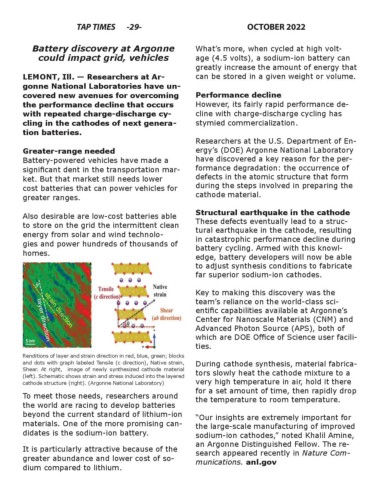
        Renditions of layer and strain direction in red, blue, green; blocks
        and dots with graph labeled Tensile (c direction), Native strain,   During cathode synthesis, material fabrica-
        Shear.  At  right,    image  of  newly  synthesized  cathode  material   tors slowly heat the cathode mixture to a
        (left). Schematic shows strain and stress induced into the layered
        cathode structure (right). (Argonne National Laboratory)  very high temperature in air, hold it there
                                                                for a set amount of time, then rapidly drop
        To meet those needs, researchers around                 the temperature to room temperature.
        the world are racing to develop batteries
        beyond the current standard of lithium-ion              “Our insights are extremely important for
        materials. One of the more promising can-               the large-scale manufacturing of improved
        didates is the sodium-ion battery.                      sodium-ion cathodes,” noted Khalil Amine,

                                                                an Argonne Distinguished Fellow. The re-
        It is particularly attractive because of the            search appeared recently in Nature Com-
        greater abundance and lower cost of so-                 munications. anl.gov
        dium compared to lithium.

