


Page 27 - october22_previewaa.indd
P. 27
TAP TIMES          -27-                                OCTOBER 2022


                  Solar material (from 26)                      manufacture into a solar device, per-
                                                                ovskites are easily processed from solution
        erial that not only harvests energy from                at room temperature to around 300oF —
        the sun but also has the added bonus of                 and for manufacturers, these lower pro-
        having a naturally, spontaneously formed                cessing temperatures would dramatically
        electric field — the possibilities across the           reduce energy costs.
        solar energy and electronics industries are
        pretty exciting,” said co-senior author Pei-            Long-standing challenges
        dong Yang.                                              Despite their potential boost to the solar
                                                                energy sector, perovskite solar materi-
        Yang is a leading nanomaterials expert                  als won’t be market-ready until research-
        known for his pioneering work in one-                   ers overcome long-standing challenges in
        dimensional semiconducting nanowires for                product synthesis and stability, and mate-
        novel solar cell technologies and artificial            rial sustainability.
        photosynthesis.
                                                                A few years ago, first author Ye Zhang,
                                                                who was a UC Berkeley graduate student
                                                                researcher in Yang’s lab at the time, won-
                                                                dered how she could make a lead-free fer-
                                                                roelectric perovskite.


                                                                She theorized that placing a germanium
                                                                atom in the center of a perovskite would
                                                                distort its crystallinity just enough to en-
                                                                gender ferroelectricity. On top of that, a
                                                                germanium-based perovskite would free
                                                                the material of lead. (Zhang is now a post-
                                                                doctoral researcher at Northwestern Uni-
                                                                versity.)
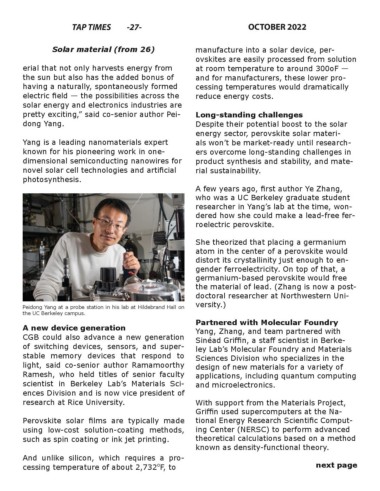
        Peidong Yang at a probe station in his lab at Hildebrand Hall on
        the UC Berkeley campus.
                                                                Partnered with Molecular Foundry
        A new device generation                                 Yang, Zhang, and team partnered with
        CGB could also advance a new generation                 Sinéad Griffin, a staff scientist in Berke-
        of  switching devices, sensors,  and  super-            ley Lab’s Molecular Foundry and Materials
        stable  memory  devices  that  respond  to              Sciences Division who specializes in the
        light, said co-senior  author  Ramamoorthy              design of new materials for a variety of
        Ramesh,  who  held  titles of  senior  faculty          applications, including quantum computing
        scientist in Berkeley  Lab’s Materials  Sci-            and microelectronics.
        ences Division and is now vice president of
        research at Rice University.                            With support from the Materials Project,
                                                                Griffin used supercomputers at the Na-
        Perovskite  solar  films  are  typically  made          tional Energy Research Scientific Comput-
        using  low-cost  solution-coating methods,              ing Center (NERSC) to perform advanced
        such as spin coating or ink jet printing.               theoretical calculations based on a method
                                                                known as density-functional theory.
        And  unlike  silicon, which requires  a  pro-
                                                    o
        cessing temperature of about 2,732 F, to                                                       next page

