


Page 32 - october22_previewaa.indd
P. 32
TAP TIMES          -32-                                   OCTOBER 2022


            LBL scientists demonstrate a
            fully biodegradable PC board


        BERKELEY, Calif. — According to the
        United Nations, less than a quarter of
        all U.S. electronic waste gets recycled.
        In 2021 alone, global e-waste surged
        at 57.4 million tons, and only 17.4%
        of that was recycled.

        E-waste problem
        Some experts predict that our e-waste
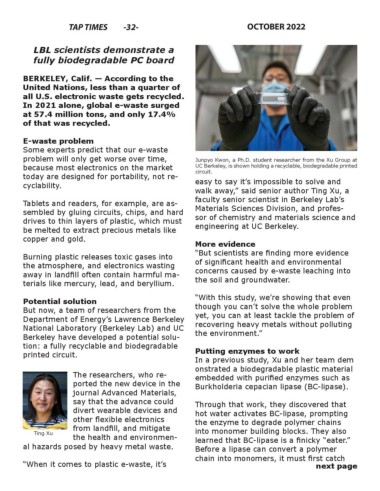
        problem will only get worse over time,                  Junpyo Kwon, a Ph.D. student researcher from the Xu Group at
        because most electronics on the market                  UC Berkeley, is shown holding a recyclable, biodegradable printed
                                                                circuit.
        today are designed for portability, not re-
        cyclability.                                            easy to say it’s impossible to solve and
                                                                walk away,” said senior author Ting Xu, a
                                                                faculty senior scientist in Berkeley Lab’s
        Tablets and readers, for example, are as-
        sembled by gluing circuits, chips, and hard             Materials Sciences Division, and profes-
        drives to thin layers of plastic, which must            sor of chemistry and materials science and
        be melted to extract precious metals like               engineering at UC Berkeley.
        copper and gold.
                                                                More evidence

        Burning plastic releases toxic gases into               “But scientists are finding more evidence
        the atmosphere, and electronics wasting                 of significant health and environmental
        away in landfill often contain harmful ma-              concerns caused by e-waste leaching into
        terials like mercury, lead, and beryllium.              the soil and groundwater.


        Potential solution                                      “With this study, we’re showing that even
        But now, a team of researchers from the                 though you can’t solve the whole problem
        Department of Energy’s Lawrence Berkeley                yet, you can at least tackle the problem of
        National Laboratory (Berkeley Lab) and UC               recovering heavy metals without polluting
        Berkeley have developed a potential solu-               the environment.”
        tion: a fully recyclable and biodegradable
        printed circuit.                                        Putting enzymes to work
                                                                In a previous study, Xu and her team dem
                                                                onstrated a biodegradable plastic material
                        The researchers, who re-                embedded with purified enzymes such as
                        ported the new device in the            Burkholderia cepacian lipase (BC-lipase).
                        journal Advanced Materials,
                        say that the advance could              Through that work, they discovered that
                        divert wearable devices and             hot water activates BC-lipase, prompting
                        other flexible electronics              the enzyme to degrade polymer chains
                        from landfill, and mitigate
            Ting Xu                                             into monomer building blocks. They also
                        the health and environmen-              learned that BC-lipase is a finicky “eater.”
        al hazards posed by heavy metal waste.                  Before a lipase can convert a polymer

                                                                chain into monomers, it must first catch
        “When it comes to plastic e-waste, it’s                                                        next page

