


Page 26 - october22_previewaa.indd
P. 26
TAP TIMES          -26-                                   OCTOBER 2022


               Lead-free solar material
           offers simpler manufacturing


        BERKELEY, Calif. — Solar panels, also
        known as photovoltaics, rely on semi-
        conductor devices or solar cells to
        convert energy from the sun into elec-
        tricity.


        To generate electricity, solar cells need an
        electric field to separate positive charges
        from negative charges. To get this field,
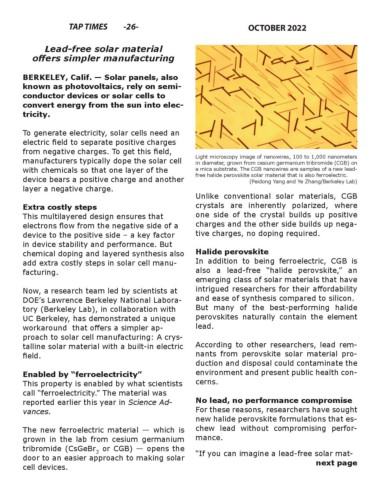
        manufacturers typically dope the solar cell             Light microscopy image of nanowires, 100 to 1,000 nanometers
                                                                in diameter, grown from cesium germanium tribromide (CGB) on
        with chemicals so that one layer of the                 a mica substrate. The CGB nanowires are samples of a new lead-
        device bears a positive charge and another              free halide perovskite solar material that is also ferroelectric.
                                                                                               (Peidong Yang and Ye Zhang/Berkeley Lab)
        layer a negative charge.
                                                                Unlike  conventional  solar  materials,  CGB

        Extra costly steps                                      crystals  are  inherently  polarized,  where
        This multilayered design ensures that                   one  side of  the  crystal builds  up positive
        electrons flow from the negative side of a              charges and the other side builds up nega-
        device to the positive side – a key factor              tive charges, no doping required.
        in device stability and performance. But
        chemical doping and layered synthesis also              Halide perovskite
        add extra costly steps in solar cell manu-              In addition to being ferroelectric,  CGB is
        facturing.                                              also  a  lead-free  “halide  perovskite,”  an
                                                                emerging class of solar materials that have

        Now, a research team led by scientists at               intrigued researchers for their affordability
        DOE’s Lawrence Berkeley National Labora-                and ease of synthesis compared to silicon.
        tory (Berkeley Lab), in collaboration with              But  many  of  the  best-performing  halide
        UC Berkeley, has demonstrated a unique                  perovskites  naturally contain  the  element
        workaround  that offers a simpler ap-                   lead.
        proach to solar cell manufacturing: A crys-
        talline solar material with a built-in electric         According to other researchers, lead rem-
        field.                                                  nants  from  perovskite  solar  material  pro-
                                                                duction and disposal could contaminate the
        Enabled by “ferroelectricity”                           environment and present public health con-
        This property is enabled by what scientists             cerns.
        call “ferroelectricity.” The material was
        reported earlier this year in Science Ad-               No lead, no performance compromise
        vances.                                                 For these reasons, researchers have sought
                                                                new halide perovskite formulations that es-
        The  new  ferroelectric  material  — which is           chew  lead  without  compromising  perfor-
        grown in the lab from cesium germanium                  mance.
        tribromide (CsGeBr  or CGB) — opens the
                                3
        door to an easier approach to making solar              “If you can imagine a lead-free solar mat-
        cell devices.                                                                                  next page

