


Page 32 - september22_082722.indd
P. 32
TAP TIMES       -32-                              SEPTEMBER 2022


                Response to light (from 31)                     the atoms are farther apart. Think of peo-
                                                                ple on a subway car. It’s easier to squeeze
         that the semiconductors changed their                  in more people if there are bigger spaces
        elasticity, a form of mechanical stiff ness,            between them,” Jaramillo says.
        when exposed to light.
                                                                “Under illumination, the atoms present are
        “Think of a bouncy ball”                                excited and become more repellent. It’s as
        “Think of a bouncy ball,” says Jaramillo.               if those people on the subway car sudden-
        “The reason it bounces is because it’s                  ly started dancing and throwing their arms
        elastic. When you throw it on the ground,               around,” he continued.
        it deforms but then immediately springs
        back (that’s why it bounces).                           Atoms resist
                                                                The result: the atoms more strongly resist
        “What we discovered, which was really                   being packed more closely together and
        quite surprising, is that the elastic proper-           the material becomes more mechanically
        ties [of semiconductors] can undergo tre-               stiff .
        mendous changes under illumination, and
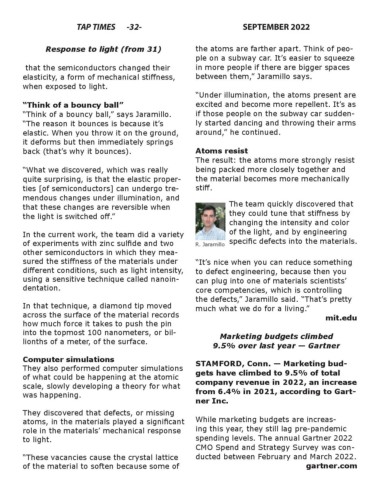
        that these changes are reversible when                             The team quickly discovered that
        the light is switched off .”                                       they could tune that stiff ness by
                                                                           changing the intensity and color
        In the current work, the team did a variety                        of the light, and by engineering
        of experiments with zinc sulfi de and two               R. Jaramillo  specifi c defects into the materials.
        other semiconductors in which they mea-
        sured the stiff ness of the materials under             “It’s nice when you can reduce something
        diff erent conditions, such as light intensity,         to defect engineering, because then you
        using a sensitive technique called nanoin-              can plug into one of materials scientists’
        dentation.                                              core competencies, which is controlling
                                                                the defects,” Jaramillo said. “That’s pretty
        In that technique, a diamond tip moved                  much what we do for a living.”
        across the surface of the material records                                                        mit.edu
        how much force it takes to push the pin
        into the topmost 100 nanometers, or bil-                        Marketing budgets climbed
        lionths of a meter, of the surface.
                                                                      9.5% over last year — Gartner
        Computer simulations                                    STAMFORD, Conn. — Marketing bud-
        They also performed computer simulations                gets have climbed to 9.5% of total
        of what could be happening at the atomic
        scale, slowly developing a theory for what              company revenue in 2022, an increase
        was happening.                                          from 6.4% in 2021, according to Gart-
                                                                ner Inc.
        They discovered that defects, or missing
        atoms, in the materials played a signifi cant           While marketing budgets are increas-
        role in the materials’ mechanical response              ing this year, they still lag pre-pandemic
        to light.                                               spending levels. The annual Gartner 2022
                                                                CMO Spend and Strategy Survey was con-
        “These vacancies cause the crystal lattice              ducted between February and March 2022.
        of the material to soften because some of                                                   gartner.com

