


Page 31 - september22_082722.indd
P. 31
TAP TIMES          -31-                                 SEPTEMBER 2022


            MIT reports semiconductors’                         pounds,” says Rafael Jaramillo, the Thom-
                 giant response to light                        as Lord Associate Professor of Materials
                                                                Science and Engineering at MIT and leader
        CAMBRIDGE, Mass. — In an example                        of the team.
        of the adage “everything old is new
        again,” MIT engineers report a new                      Elastic response
        discovery in semiconductors, well-
        known materials that have been the                      Says Ju Li, another MIT professor involved
        focus of intense study for over 100                     in the work, “to see defects having such
        years thanks to their many applica-                     big effects on elastic response is very sur-
        tions in electronic devices.                            prising, which opens the door to a variety
                                                                of applications. Computation could help us
        Light makes chips stiffer                               screen many more such materials.”
        The team found that these important ma-
        terials not only become much stiffer in re-             Li is the Battelle Energy Alliance Professor
        sponse to light, but the effect is reversible           in Nuclear Science and Engineering (NSE)
        when the light is turned off.                           with a joint appointment in the Depart-
                                                                ment of Materials Science and Engineering
                                                                (DMSE). Both Jaramillo and Li are also af-
                                                                filiated with the Materials Research Labo-
                                                                ratory.

                                                                The work is reported in a recent issue
                                                                of Physical Review Letters. The result-
                                                                ing paper was highlighted as an Editors’
                                                                Suggestion. It is also the focus of an ac-
                                                                companying synopsis for Physics Magazine
                                                                titled “Semiconductors in the Spotlight,” by
                                                                Sophia Chen.


                                                                Jaramillo remembers being intrigued by
                                                                a 2018 paper in Science showing how a
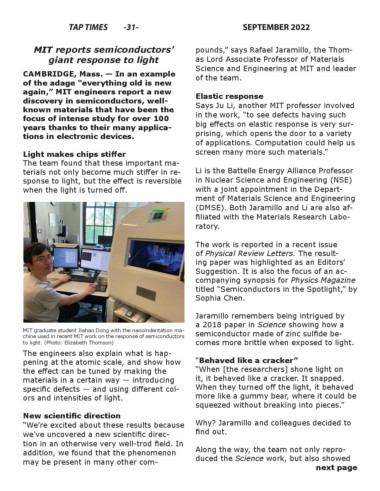
        MIT graduate student Jiahao Dong with the nanoindentation ma-  semiconductor made of zinc sulfide be-
        chine used in recent MIT work on the response of semiconductors
        to light. (Photo: Elizabeth Thomson)                    comes more brittle when exposed to light.
        The engineers also explain what is hap-
        pening at the atomic scale, and show how                “Behaved like a cracker”
        the effect can be tuned by making the                   “When [the researchers] shone light on
        materials in a certain way — introducing                it, it behaved like a cracker. It snapped.
        specific defects — and using different col-             When they turned off the light, it behaved
        ors and intensities of light.                           more like a gummy bear, where it could be
                                                                squeezed without breaking into pieces.”
        New scientific direction
        “We’re excited about these results because              Why? Jaramillo and colleagues decided to
        we’ve uncovered a new scientific direc-                 find out.
        tion in an otherwise very well-trod field. In
        addition, we found that the phenomenon                  Along the way, the team not only repro-
        may be present in many other com-                       duced the Science work, but also showed
                                                                                                       next page

