


Page 43 - november_ 22_102722aa.indd
P. 43
TAP TIMES      -43-                                     NOVEMBER 2022


             Ferroelectric material (from 42)                     materials, Cheema said. “This greatly ex-

                                                                pands the materials design space for next-
                                                                generation electronics to include materials
        This is surprising for a material that is not
        even typically ferroelectric in its bulk form.          already compatible with silicon technolo-
                                                                gies.”

        Polarization switched                                   Beyond graphene
        The researchers were also able to switch
        the polarization in this ultrathin mate-                As Cheema noted, simply growing just a
        rial back and forth with a small voltage,               few atomic layers of a 3D material can
        enabling the thinnest demonstration of a                offer the potential for a new class of 2D
        working memory ever reported on silicon.                materials — atomically-thin 3D materials
                                                                — that go beyond conventional sheets of
                                                                2D materials like graphene.
        It also offers substantial promise for en-
        ergy-efficient electronics, especially con-
        sidering conventional zirconium dioxide is              The researchers hope this work will moti-
        already present in today’s state-of-the-art             vate more research into two-dimensional
        silicon chips.                                          3D materials exhibiting emergent electron-
                                                                ic phenomena relevant for energy-efficient
                        “This work takes a key step             electronics.
                        towards integrating ferro-
                        electrics into highly scaled            This work was led by Cheema and Sayeef
                        microelectronics,” said Suraj           Salahuddin of UC Berkeley, along with co-
                        Cheema, a postdoctoral re-              first authors Nirmaan Shanker and Shang-
                        searcher at UC Berkeley, the            Lin Hsu.
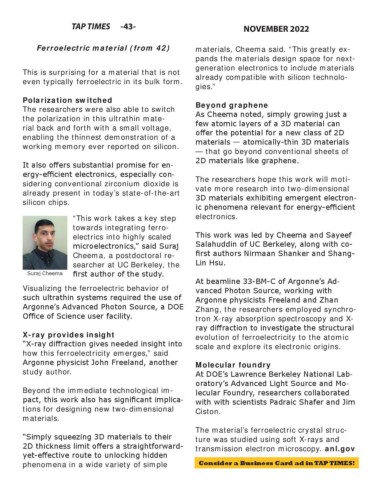
          Suraj Cheema  first author of the study.
                                                                At beamline 33-BM-C of Argonne’s Ad-
        Visualizing the ferroelectric behavior of               vanced Photon Source, working with
        such ultrathin systems required the use of              Argonne physicists Freeland and Zhan
        Argonne’s Advanced Photon Source, a DOE                 Zhang, the researchers employed synchro-
        Office of Science user facility.                        tron X-ray absorption spectroscopy and X-
                                                                ray diffraction to investigate the structural
        X-ray provides insight                                  evolution of ferroelectricity to the atomic
        “X-ray diffraction gives needed insight into            scale and explore its electronic origins.
        how this ferroelectricity emerges,” said
        Argonne physicist John Freeland, another                Molecular foundry
        study author.                                           At DOE’s Lawrence Berkeley National Lab-
                                                                oratory’s Advanced Light Source and Mo-
        Beyond the immediate technological im-                  lecular Foundry, researchers collaborated
        pact, this work also has significant implica-           with with scientists Padraic Shafer and Jim
        tions for designing new two-dimensional                 Ciston.
        materials.

                                                                The material’s ferroelectric crystal struc-
          “Simply squeezing 3D materials to their               ture was studied using soft X-rays and
        2D thickness limit offers a straightforward-            transmission electron microscopy. anl.gov
        yet-effective route to unlocking hidden
        phenomena in a wide variety of simple                    Consider a Business Card ad in TAP TIMES!

