


Page 42 - november_ 22_102722aa.indd
P. 42
TAP TIMES      -42-                                     NOVEMBER 2022


          Thinnest ferroelectric material                       Unfortunately, conventional ferroelectric
           may improve device effi  ciency                        materials lose their internal polarization
                                                                below around a few nanometers in thick-
                                                                ness.
        Lemont, Ill. — As electronic devices
        become smaller and smaller, the ma-                     A compatibility issue
        terials that power them need to be-                     This means they are not compatible with
        come thinner and thinner.                               current-day silicon technology. This issue

                                                                has previously prevented the integration of
        Ultrathin devices                                       ferroelectrics into microelectronics.
        Because of this, one of the key challenges
        scientists face in developing next-genera-              Now, however, a team of researchers from
        tion energy-effi  cient electronics is discov-          the University of California at Berkeley
        ering materials that can maintain special               performing experiments at the U.S.
        electronic properties at an ultrathin size.                        Department of Energy’s (DOE)

                                                                           Argonne National Laboratory
                                                                           have found a solution that si-
                                                                           multaneously solves both prob-
                                                                           lems by creating the thinnest
                                                                           ferroelectric ever reported and
                                                                           the thinnest demonstration of a
                                                                           working memory on silicon.


                                                                           In a study published in Science,
                                                                           the research team discovered
                                                                           stable ferroelectricity in an ultra-
                                                                           thin layer of zirconium dioxide
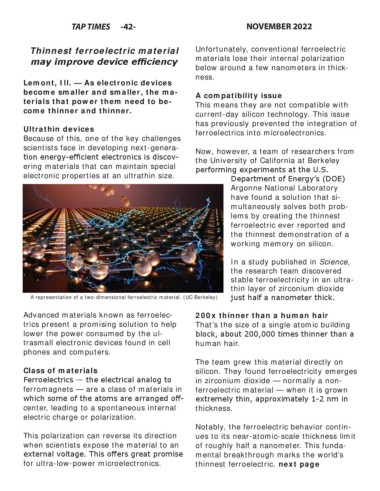
           A representation of a two-dimensional ferroelectric material. (UC Berkeley)  just half a nanometer thick.

        Advanced materials known as ferroelec-                  200x thinner than a human hair
        trics present a promising solution to help              That’s the size of a single atomic building
        lower the power consumed by the ul-                     block, about 200,000 times thinner than a
        trasmall electronic devices found in cell               human hair.
        phones and computers.
                                                                The team grew this material directly on
        Class of materials                                      silicon. They found ferroelectricity emerges
        Ferroelectrics — the electrical analog to               in zirconium dioxide — normally a non-
        ferromagnets — are a class of materials in              ferroelectric material — when it is grown
        which some of the atoms are arranged off -              extremely thin, approximately 1-2 nm in
        center, leading to a spontaneous internal               thickness.
        electric charge or polarization.
                                                                Notably, the ferroelectric behavior contin-
        This polarization can reverse its direction             ues to its near-atomic-scale thickness limit
        when scientists expose the material to an               of roughly half a nanometer. This funda-
        external voltage. This off ers great promise            mental breakthrough marks the world’s
        for ultra-low-power microelectronics.                   thinnest ferroelectric. next page

