


Page 36 - january23_122922.indd
P. 36
TAP TIMES      -36-                                      JANUARY 2023


              Flameproofing lithium-ion                         ies containing this electrolyte continue to
                    batteries with salt                         function at high temperatures without
                                                                starting a fire.
        STANFORD, Calif. — Rechargeable
        lithium-ion batteries power phones,                     Their secret? More salt.
        laptops, other personal electronics
        and electric cars, and are even used to                 Potential firestarter
        store energy generated by solar pan-                    Conventional lithium-ion battery electro-
        els. But if the temperature of these                    lytes are made of a lithium salt dissolved
        batteries rises too high, they stop                     in a liquid organic solvent, such as ether
        working and can catch fire.                             or carbonate. While this solvent improves
                                                                battery performance by helping to move
        Flammable electrolyte                                   lithium ions around, it’s also a potential
        That’s in part because the electrolyte in-              firestarter.
        side of them, which ferries lithium ions
        between the two electrodes as the battery               Batteries generate heat as they operate.
        charges and discharges, is flammable.                   And if there are punctures or defects in a
                                                                battery, it will heat up rapidly. At tempera-
                                                                tures above 140 degrees F, the small mol-
                                                                ecules of solvent in the electrolyte start to
                                                                evaporate, transforming from liquid to gas
                                                                and inflating a battery like a balloon — un-
                                                                til the gas catches fire and the whole thing
                                                                goes up in flames.


                                                                Over the past 30 years researchers have
                                                                developed non-flammable electrolytes,
                                                                such as polymer electrolytes, which use a
                                                                polymer matrix instead of the classic salt-
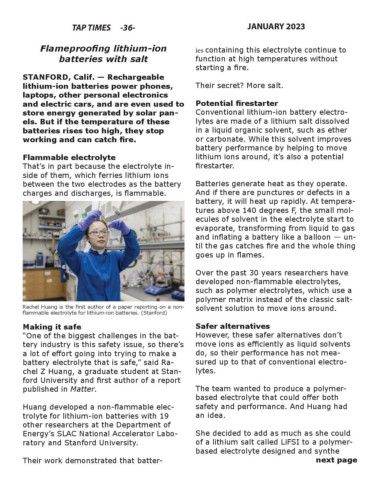
        Rachel Huang is the first author of a paper reporting on a non-  solvent solution to move ions around.
        flammable electrolyte for lithium-ion batteries. (Stanford)

        Making it safe                                          Safer alternatives
        “One of the biggest challenges in the bat-              However, these safer alternatives don’t
        tery industry is this safety issue, so there’s          move ions as efficiently as liquid solvents
        a lot of effort going into trying to make a             do, so their performance has not mea-
        battery electrolyte that is safe,” said Ra-             sured up to that of conventional electro-
        chel Z Huang, a graduate student at Stan-               lytes.
        ford University and first author of a report
        published in Matter.                                    The team wanted to produce a polymer-
                                                                based electrolyte that could offer both
        Huang developed a non-flammable elec-                   safety and performance. And Huang had
        trolyte for lithium-ion batteries with 19               an idea.
        other researchers at the Department of
        Energy’s SLAC National Accelerator Labo-                She decided to add as much as she could
        ratory and Stanford University.                         of a lithium salt called LiFSI to a polymer-
                                                                based electrolyte designed and synthe
        Their work demonstrated that batter-                                                           next page

