


Page 27 - december22_112922.indd
P. 27
TAP TIMES       -27-                               DECEMBER 2022


                  CalTech solves a 175                          When Gauss was young, he amazed his
                year-old math problem                           classmates by quickly developing a formu-
                                                                la for adding up the numbers 1 to 100.
        Pasadena, Calif. —For the past 175
        years, a perplexing feature of num-                     Distribution of solutions
        bers first discovered by Ernst Kum-                     Gauss later developed a complex concept
        mer, a German mathematician, has                        known as Gauss sums, which readily map
        confounded researchers.                                 the distribution of solutions to equations.


        Number theory                                           He looked at the distribution of what are
                                                                called square Gauss sums for nontrivial
        At one point in the 1950s, this quirky                  prime numbers (primes that have a re-
        feature of number theory was thought to                 mainder of 1 when you divide by 3) and
        have been wrong, but then, decades later,               found a “beautiful structure,” according to
        mathematicians found hints that it was in               Radziwill.
        fact true.

                                                                This summing activity involves a type of
        Now, after several twists and turns, two                math known as modular arithmetic. An
        Caltech mathematicians have at last found               easy way to understand modular arithme-
        proof that Kummer was right all along.                  tic is to think of a clock and its face divid-
                                                                ed into 12 hours.
        “We had several ‘aha’ moments, but then
        you have to roll up your sleeves and figure             When noon or midnight rolls around, the
        this out,” explains Alexander (Alex) Dunn,              numbers are reset and go back to 1. This
        a postdoc at Caltech who wrote the proof                “modulo 12” system simplifies timekeep-
        with his advisor, professor of mathematics              ing, since we do not have to keep counting
        Maksym Radziwill and posted it online in                up hours forever.
        September 2021.
                                                                Making equations simpler
        Gauss sums                                              In the case of Gauss sums, the same idea
        The math problem has to do with Gauss                   is at play but the base “clock face” is di-
        sums, which are named after the 18th-                   vided up into p hours, where p is a prime
        century prolific mathematician Carl Fried-              number. “Modulo p math is a way of strip-
        rich Gauss.                                             ping out information and making impossi-
                                                                bly complicated equations simpler,” Radzi-
                                                                will says.

                                                                Mathematician Samuel Patterson who
                                                                proposed a solution to the mix-up in 1978,
                                                                now referred to as Patterson’s conjecture.

                                                                He was a graduate student at the Univer-
                                                                sity of Cambridge at the time and recog-
                                                                nized that the bias in the distribution of
                                                                the solutions could be overwhelmed as the
                                                                sample size gets bigger and bigger.
                                                                                                       next page
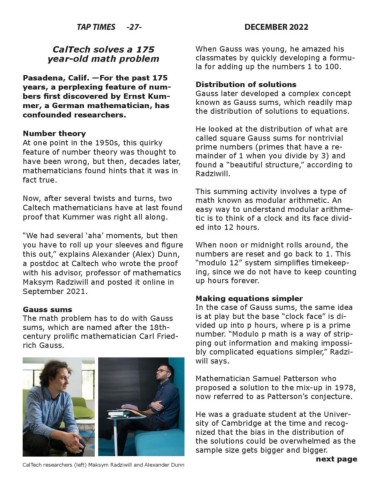
        CalTech researchers (left) Maksym Radziwill and Alexander Dunn

