


Page 25 - december22_112922.indd
P. 25
TAP TIMES      -25-                                     DECEMBER 2022


               MIT researchers develop                          and at room temperature and pressure.

              low-cost terahertz camera                         What’s more, it can simultaneously cap-
                                                                ture information about the orientation, or

        CAMBRIDGE, Mass. — Terahertz radia-                     “polarization,” of the waves in real-time,
        tion, whose wavelengths lie between                     which existing devices cannot.
        those of microwaves and visible light,
        can penetrate many nonmetallic ma-                      Materials characterization
        terials and detect signatures of cer-                   This information can be used to character-
        tain molecules.                                         ize materials that have asymmetrical mol-
                                                                ecules or to determine the surface topog-
        Many applications                                       raphy of materials.
        These handy qualities could lend them-                  The new system uses particles called
        selves to a wide array of applications, in-
        cluding airport security scanning, industrial           quantum dots, which, it has recently been
        quality control, astrophysical observations,            found, can emit visible light when stimu-
        nondestructive characterization of mate-                lated by terahertz waves.
        rials, and wireless communications with                 The visible light can then be recorded by
        higher bandwidth than current cellphone
        bands.                                                  a device that is similar to a standard elec-
                                                                tronic camera’s detector and can even be
        However, designing devices to detect and                seen with the naked eye.
        make images from terahertz waves has                    The device is described in a paper pub-
        been challenging, and most existing tera-
        hertz devices are expensive, slow, bulky,               lished in Nature Nanotechnology, by MIT
        and require vacuum systems and extreme-                 doctoral student Jiaojian Shi, professor of
        ly low temperatures.                                    chemistry Keith Nelson, and 12 others.

                                                                Two different devices
        Now, researchers at MIT, the University of
        Minnesota, and Samsung have developed                   The team produced two different devices
        a new kind of camera that can detect tera-              that can operate at room temperature:
        hertz pulses rapidly, with high sensitivity,            One uses the quantum dot’s ability to
                                                                convert terahertz pulses to visible light,
                                                                enabling the device to produce images
                                                                of materials; the other produces images
                                                                showing the polarization state of the tera-
                                                                hertz waves.

                                                                The new “camera” consists of several lay-
                                                                ers, made with standard manufacturing
                                                                techniques like those used for microchips.
                                                                The photons of terahertz radiation have
                                                                extremely low energy, Nelson explains,
                                                                which makes them hard to detect.


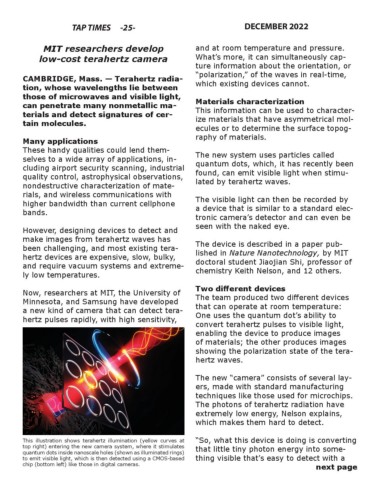
        This illustration shows terahertz illumination (yellow  curves  at   “So, what this device is doing is converting
        top right) entering the new camera system, where it stimulates   that little tiny photon energy into some-
        quantum dots inside nanoscale holes (shown as illuminated rings)
        to emit visible light, which is then detected using a CMOS-based   thing visible that’s easy to detect with a
        chip (bottom left) like those in digital cameras.                                              next page

