


Page 34 - august_072922.indd
P. 34
TAP TIMES       -34-                                AUGUST 2022


               Ultrathin capacitor could                        First discov-
            enable energy-efficient chips                       ered more than

                                                                80 years ago,
        BERKELEY, Calif. — The silicon-based                    barium titanate
        computer chips that power our mod-                      (BaTiO3) found
        ern devices require vast amounts of                     use in various
        energy to operate.                                      capacitors for
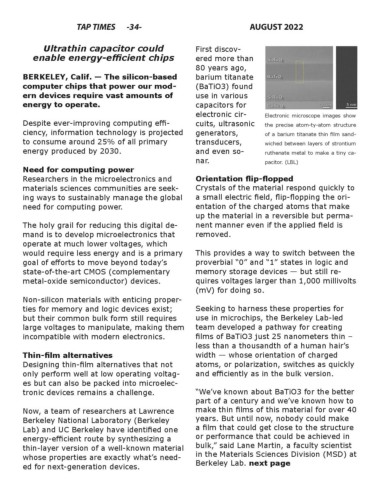
                                                                electronic cir-       Electronic microscope  images  show
        Despite ever-improving computing effi-                  cuits, ultrasonic     the  precise  atom-ty-atom  structure
        ciency, information technology is projected             generators,           of a barium titanate thin film sand-
        to consume around 25% of all primary                    transducers,          wiched between layers of strontium
        energy produced by 2030.                                and even so-          ruthenate metal to make a tiny ca-
                                                                nar.                  pacitor. (LBL)
        Need for computing power
        Researchers in the microelectronics and                 Orientation flip-flopped
        materials sciences communities are seek-                Crystals of the material respond quickly to
        ing ways to sustainably manage the global               a small electric field, flip-flopping the ori-
        need for computing power.                               entation of the charged atoms that make
                                                                up the material in a reversible but perma-
        The holy grail for reducing this digital de-            nent manner even if the applied field is
        mand is to develop microelectronics that                removed.
        operate at much lower voltages, which
        would require less energy and is a primary              This provides a way to switch between the
        goal of efforts to move beyond today’s                  proverbial “0” and “1” states in logic and
        state-of-the-art CMOS (complementary                    memory storage devices — but still re-
        metal-oxide semiconductor) devices.                     quires voltages larger than 1,000 millivolts
                                                                (mV) for doing so.
        Non-silicon materials with enticing proper-
        ties for memory and logic devices exist;                Seeking to harness these properties for
        but their common bulk form still requires               use in microchips, the Berkeley Lab-led
        large voltages to manipulate, making them               team developed a pathway for creating
        incompatible with modern electronics.                   films of BaTiO3 just 25 nanometers thin –
                                                                less than a thousandth of a human hair’s
        Thin-film alternatives                                  width — whose orientation of charged
        Designing thin-film alternatives that not               atoms, or polarization, switches as quickly
        only perform well at low operating voltag-              and efficiently as in the bulk version.
        es but can also be packed into microelec-
        tronic devices remains a challenge.                     “We’ve known about BaTiO3 for the better
                                                                part of a century and we’ve known how to
        Now, a team of researchers at Lawrence                  make thin films of this material for over 40
        Berkeley National Laboratory (Berkeley                  years. But until now, nobody could make
        Lab) and UC Berkeley have identified one                a film that could get close to the structure
        energy-efficient route by synthesizing a                or performance that could be achieved in
        thin-layer version of a well-known material             bulk,” said Lane Martin, a faculty scientist
        whose properties are exactly what’s need-               in the Materials Sciences Division (MSD) at
        ed for next-generation devices.                         Berkeley Lab. next page

