


Page 21 - august_072922.indd
P. 21
TAP TIMES          -21-                                 AUGUST 2022


                   Perovskites (from 20)

        to separate into a 2D layered structure, or
        lose ordered structure entirely,” says Tonio
        Buonassisi, professor of mechanical engi-
        neering at MIT and director of the Photo-
        voltaics Research Laboratory.

        Highly tunable
        “Perovskites are highly tunable, like a
        build-your-own-adventure type of crystal
        structure,” he says.
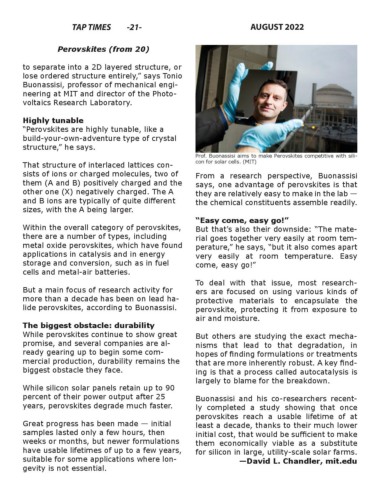
                                                                Prof. Buonassisi aims to make Perovskites competitive with sili-
        That structure of interlaced lattices con-              con for solar cells. (MIT)
        sists of ions or charged molecules, two of              From  a  research  perspective,  Buonassisi
        them (A and B) positively charged and the               says, one advantage of perovskites is that
        other one (X) negatively charged. The A                 they are relatively easy to make in the lab —
        and B ions are typically of quite different             the chemical constituents assemble readily.
        sizes, with the A being larger.
                                                                “Easy come, easy go!”
        Within the overall category of perovskites,             But that’s also their downside: “The mate-
        there are a number of types, including                  rial goes together very easily at room tem-
        metal oxide perovskites, which have found               perature,” he says, “but it also comes apart
        applications in catalysis and in energy                 very  easily  at  room  temperature.  Easy
        storage and conversion, such as in fuel                 come, easy go!”
        cells and metal-air batteries.
                                                                To  deal  with that  issue,  most  research-
        But a main focus of research activity for               ers  are  focused  on  using  various  kinds  of
        more than a decade has been on lead ha-                 protective materials  to encapsulate  the
        lide perovskites, according to Buonassisi.              perovskite, protecting it from exposure to
                                                                air and moisture.
        The biggest obstacle: durability
        While perovskites continue to show great                But others are studying the exact mecha-
        promise, and several companies are al-                  nisms  that  lead  to  that  degradation,  in
        ready gearing up to begin some com-                     hopes of finding formulations or treatments
        mercial production, durability remains the              that are more inherently robust. A key find-
        biggest obstacle they face.                             ing is that a process called autocatalysis is
                                                                largely to blame for the breakdown.
        While silicon solar panels retain up to 90
        percent of their power output after 25                  Buonassisi  and  his  co-researchers  recent-
        years, perovskites degrade much faster.                 ly completed  a  study  showing that  once
                                                                perovskites  reach  a  usable  lifetime  of  at
        Great progress has been made — initial                  least a decade, thanks to their much lower
        samples lasted only a few hours, then                   initial cost, that would be sufficient to make
        weeks or months, but newer formulations                 them  economically viable as  a  substitute
        have usable lifetimes of up to a few years,             for silicon in large, utility-scale solar farms.
        suitable for some applications where lon-                             —David L. Chandler, mit.edu
        gevity is not essential.

