


Page 38 - september22_082722.indd
P. 38
TAP TIMES       -38-                              SEPTEMBER 2022


                   New chip ramps-up                            the memory itself, thereby eliminating
                AI computing efficiency                         the separation between the compute and

                                                                memory units.
        STANFORD, Calif. — AI-powered edge
        computing is already pervasive in our                   “Compute-in-Memory” chip
        lives.                                                  Their “compute-in-memory” (CIM) chip,
                                                                called NeuRRAM, is about the size of a
        Devices like drones, smart wearables, and               fingertip and does more work with limited
        industrial IoT sensors are equipped with                battery power than what current chips can
        AI-enabled chips so that computing can                  do.
        occur at the “edge” of the internet, where
        the data originates. This allows real-time                                “Having those calculations
        processing and guarantees data privacy.                                   done on the chip instead of
                                                                                  sending information to and
                                                                                  from the cloud could enable
                                                                                  faster, more secure, cheap-
                                                                                  er, and more scalable AI
                                                                going into the future, and give more peo-
                                                                ple access to AI power,” said H.-S Philip
                                                                Wong (above), the Willard R. and Inez
                                                                Kerr Bell Professor in the School of Engi-
                                                                neering.


                                                                The data movement issue
                                                                “The data movement issue is similar to
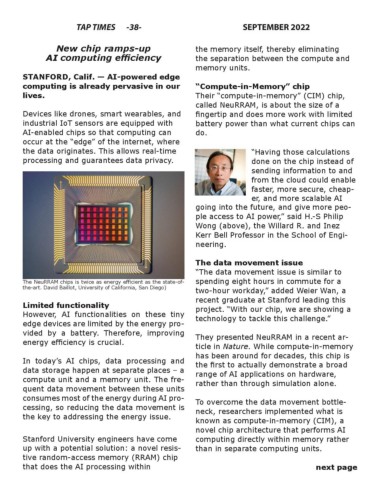
        The NeuRRAM chips is twice as energy efficient as the state-of-  spending eight hours in commute for a
        the-art. David Baillot, University of California, San Diego)  two-hour workday,” added Weier Wan, a

                                                                recent graduate at Stanford leading this
        Limited functionality                                   project. “With our chip, we are showing a
        However,  AI  functionalities  on  these  tiny          technology to tackle this challenge.”
        edge devices are limited by the energy pro-
        vided  by  a  battery.  Therefore,  improving           They presented NeuRRAM in a recent ar-
        energy efficiency is crucial.                           ticle in Nature. While compute-in-memory

                                                                has been around for decades, this chip is
        In today’s AI  chips, data  processing and              the first to actually demonstrate a broad
        data storage happen at separate places – a              range of AI applications on hardware,
        compute unit and a memory unit. The fre-                rather than through simulation alone.
        quent data movement between these units
        consumes most of the energy during AI pro-              To overcome the data movement bottle-
        cessing, so reducing the data movement is               neck, researchers implemented what is
        the key to addressing the energy issue.                 known as compute-in-memory (CIM), a

                                                                novel chip architecture that performs AI
        Stanford University engineers have come                 computing directly within memory rather
        up with a potential solution: a novel resis-            than in separate computing units.
        tive random-access memory (RRAM) chip
        that does the AI processing within                                                             next page

