


Page 21 - september22_082722.indd
P. 21
TAP TIMES      -21-                                 SEPTEMBER 2022


         Nanoparticle growth determined                         Using a technique called high-resolution
         by defects, not difference in size                     liquid cell transmission electron microsco-

                                                                py (LC-TEM) at the Molecular Foundry, the
        BERKELEY, Calif. — For decades, a                       researchers captured real-time, atomic-
        textbook process known as “Ostwald                      scale LC-TEM videos of Cd-CdCl2 CSNPs
        ripening,” named for the Nobel Prize-                   ripening in solution.
        winning chemist Wilhelm Ostwald,
        has guided the design of new materi-                    Key experiment
        als including nanoparticles – tiny ma-                  In one key experiment, an LC-TEM vid-
        terials so small they are invisible to                  eo shows a small Cd-CdCl2 core-shell
        the naked eye.                                          nanoparticle merging with a large Cd-Cd-

                                                                Cl2 CSNP to form a larger Cd-CdCl2 CSNP.
        According to this theory, small particles
        dissolve and redeposit onto the surface of                                             However, the di-
        large particles, and the large particles con-                                          rection of growth
        tinue to grow until all of the small particles                                         was guided not
        have dissolved.                                                                        by a difference
                                                                                               in size but by a
        Vido demolishes old belief                                                             crack defect in
        But now, new video footage captured                                                    the shell of the
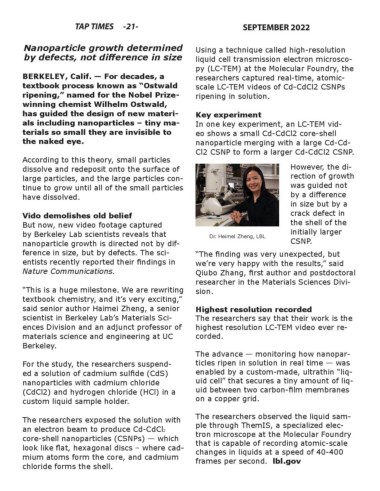
        by Berkeley Lab scientists reveals that                     Dr. Heimel Zheng, LBL      initially larger
        nanoparticle growth is directed not by dif-                                            CSNP.
        ference in size, but by defects. The sci-               “The finding was very unexpected, but
        entists recently reported their findings in             we’re very happy with the results,” said
        Nature Communications.                                  Qiubo Zhang, first author and postdoctoral
                                                                researcher in the Materials Sciences Divi-
        “This is a huge milestone. We are rewriting             sion.
        textbook chemistry, and it’s very exciting,”
        said senior author Haimei Zheng, a senior               Highest resolution recorded
        scientist in Berkeley Lab’s Materials Sci-              The researchers say that their work is the
        ences Division and an adjunct professor of              highest resolution LC-TEM video ever re-
        materials science and engineering at UC                 corded.
        Berkeley.
                                                                The advance — monitoring how nanopar-
        For the study, the researchers suspend-                 ticles ripen in solution in real time — was
        ed a solution of cadmium sulfide (CdS)                  enabled by a custom-made, ultrathin “liq-
        nanoparticles with cadmium chloride                     uid cell” that secures a tiny amount of liq-
        (CdCl2) and hydrogen chloride (HCl) in a                uid between two carbon-film membranes
        custom liquid sample holder.                            on a copper grid.


        The researchers exposed the solution with               The researchers observed the liquid sam-
        an electron beam to produce Cd-CdCl2                    ple through ThemIS, a specialized elec-
        core-shell nanoparticles (CSNPs) — which                tron microscope at the Molecular Foundry
        look like flat, hexagonal discs – where cad-            that is capable of recording atomic-scale
                                                                changes in liquids at a speed of 40-400
        mium atoms form the core, and cadmium                   frames per second.  lbl.gov
        chloride forms the shell.

