


Page 6 - november_ 22_102722aa.indd
P. 6
TAP TIMES          -6-                             NOVEMBER 2022


                       Memory (from 4)                          Like so many technology inventions of the
                                                                day, the MOSFET was developed at Bell
        After it emerged from legal protection, the             Labs in New Jersey by Mohamed Atalla
        company’s market had changed direction,                 and Dawon Kahng in 1959. Then, in 1964,
        and Wang Labs was unable to move into                   John Schmidt at Fairchild Semiconductor
        new fields successfully.  The company has               developed MOS memory.
        since been sold several times.

        Semiconductor memory
        The computing industry bid farewell to
        clunky, outsized core memory in the early
        1960s with the introduction of bipolar
        memory by Texas Instruments.


        This memory, noted Wikipedia, was made
        from bipolar transistors.  It was first em-
        ployed by the U.S. Air Force in 1961.  That
        year, the application of solid-state memory
        on an IC was proposed by Bob Norman at
        Fairchild Semiconductor in Mountain View,
        Calif.
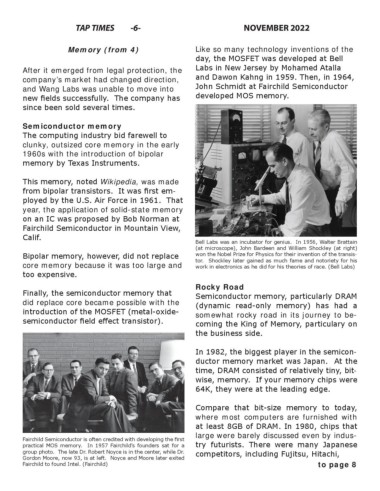
                                                                Bell Labs was an incubator for genius.  In 1956, Walter Brattain
                                                                (at microscope), John Bardeen and William Shockley (at right)
        Bipolar memory, however, did not replace                won the Nobel Prize for Physics for their invention of the transis-
        core memory because it was too large and                tor.  Shockley later gained as much fame and notoriety for his
                                                                work in electronics as he did for his theories of race. (Bell Labs)
        too expensive.

                                                                Rocky Road
        Finally, the semiconductor memory that                  Semiconductor memory, particularly DRAM
        did replace core became possible with the               (dynamic  read-only  memory)  has  had  a
        introduction of the MOSFET (metal-oxide-                somewhat rocky road in its journey to be-
        semiconductor field effect transistor).                 coming the King of Memory, particulary on
                                                                the business side.


                                                                In 1982, the biggest player in the semicon-
                                                                ductor memory market was Japan.  At the
                                                                time, DRAM consisted of relatively tiny, bit-
                                                                wise, memory.  If your memory chips were
                                                                64K, they were at the leading edge.

                                                                Compare  that  bit-size  memory  to  today,
                                                                where most computers are furnished with
                                                                at least 8GB of DRAM. In 1980, chips that
                                                                large were barely discussed even by indus-
        Fairchild Semiconductor is often credited with developing the first
        practical  MOS  memory.    In  1957  Fairchild’s  founders  sat  for  a   try  futurists.  There  were  many  Japanese
        group photo.  The late Dr. Robert Noyce is in the center, while Dr.   competitors, including Fujitsu, Hitachi,
        Gordon Moore, now 93, is at left.  Noyce and Moore later exited
        Fairchild to found Intel. (Fairchild)                                                           to page 8

