


Page 4 - november_ 22_102722aa.indd
P. 4
TAP TIMES          -4-                                  NOVEMBER 2022


                       Memory (from 3)                          mainframe computer makers adapted his
                                                                patent for their machines.
        trieve data in a computer using magnetic
        devices, the biography reports.                         Royalties and legal battles
                                                                Wang earned substantial royalties from his
        Magnetic properties                                     invention, although it required a long legal
        The Chinese-American engineer, according                battle with IBM and other mainframe mak-
        to a biography, studied the magnetic prop-              ers to receive what he believed were his
        erties of magnetic core material and devel-             just payments for the patent.
        oped a process to store data in them.
                                                                In 1951, Wang left the Harvard Lab, un-
        Not surprisingly, researchers at nearby                 happy with allowing others to control his
        MIT were also interested in magnetic core               inventions.
        storage and developed the process for use
        in computers.                                           He and several investors then formed
                                                                Wang Laboratories in Cambridge, Mass.,
                                                                which became a principal seller in products
                                                                for magnetic tape control and numerical
                                                                control.


                                                                IBM’s iconic System/360 was one of the first mainframes to em-
                                                                ploy Wang’s core memory. (IBM)

                                                                Giant supplier of desktop peripherals
                                                                Wang Labs grew to become a giant interna-
                                                                tional company supplying desktop calcula-
                                                                tors and word processing systems. In 1983,
                                                                Dr. Wang retired as president, retaining the
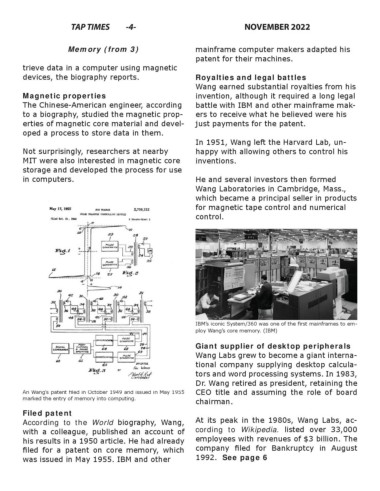
        An Wang’s patent filed in October 1949 and issued in May 1955     CEO  title  and  assuming  the  role  of  board
        marked the entry of memory into computing.              chairman.
        Filed patent
        According  to  the  World  biography,  Wang,            At  its  peak  in  the  1980s,  Wang  Labs,  ac-
        with  a  colleague,  published  an  account  of         cording to  Wikipedia.  listed  over  33,000
        his results in a 1950 article. He had already           employees with revenues of $3 billion. The
        filed  for  a  patent  on  core  memory,  which         company  filed  for  Bankruptcy  in  August
        was issued in May 1955. IBM and other                   1992.  See page 6

