


Page 17 - november_ 22_102722aa.indd
P. 17
TAP TIMES          -17-                                  NOVEMBER 2022


                      Memory (from 16)


        The jury also found that Apple did not
        infringe five Samsung patents cited in the
        litigation. Apple also sought to ban the
        sale of eight Samsung phone models, a
        request that was denied.


        Rise to semiconductor giant
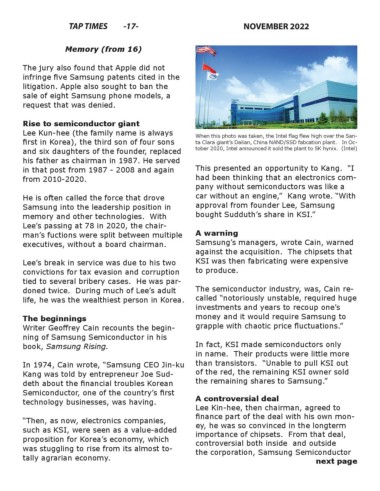
        Lee Kun-hee (the family name is always                  When this photo was taken, the Intel flag flew high over the San-
        first in Korea), the third son of four sons             ta Clara giant’s Dalian, China NAND/SSD fabcation plant.   In Oc-
        and six daughters of the founder, replaced              tober 2020, Intel announced it sold the plant to SK hynix.  (Intel)
        his father as chairman in 1987. He served
        in that post from 1987 - 2008 and again                 This presented an opportunity to Kang.  “I
        from 2010-2020.                                         had been thinking that an electronics com-
                                                                pany without semiconductors was like a
        He is often called the force that drove                 car without an engine,”  Kang wrote. “With
        Samsung into the leadership position in                 approval from founder Lee, Samsung
        memory and other technologies.  With                    bought Sudduth’s share in KSI.”
        Lee’s passing at 78 in 2020, the chair-
        man’s fuctions were split between multiple              A warning
        executives, without a board chairman.                   Samsung’s managers, wrote Cain, warned
                                                                against the acquisition.  The chipsets that
        Lee’s break in service was due to his two               KSI was then fabricating were expensive
        convictions for tax evasion and corruption              to produce.
        tied to several bribery cases.  He was par-
        doned twice.  During much of Lee’s adult                The semiconductor industry, was, Cain re-
        life, he was the wealthiest person in Korea.            called “notoriously unstable, required huge
                                                                investments and years to recoup one’s
        The beginnings                                          money and it would require Samsung to
        Writer Geoffrey Cain recounts the begin-                grapple with chaotic price fluctuations.”
        ning of Samsung Semiconductor in his
        book, Samsung Rising.                                   In fact, KSI made semiconductors only
                                                                in name.  Their products were little more

        In 1974, Cain wrote, “Samsung CEO Jin-ku                than transistors.  “Unable to pull KSI out
        Kang was told by entrepreneur Joe Sud-                  of the red, the remaining KSI owner sold
        deth about the financial troubles Korean                the remaining shares to Samsung.”
        Semiconductor, one of the country’s first
        technology businesses, was having.                      A controversial deal
                                                                Lee Kin-hee, then chairman, agreed to
                                                                finance part of the deal with his own mon-
        “Then, as now, electronics companies,                   ey, he was so convinced in the longterm
        such as KSI, were seen as a value-added                 importance of chipsets.  From that deal,
        proposition for Korea’s economy, which                  controversial both inside  and outside
        was stuggling to rise from its almost to-               the corporation, Samsung Semiconductor
        tally agrarian economy.                                                                               next page

