


Page 13 - november_ 22_102722aa.indd
P. 13
Samsung may spend $200 billion on 11 Texas fabs over 20 years

                            TAP TIMES          -13-                             NOVEMBER 2022


                      Memory (from 12)

        The Chinese would love to capture even

        a tiny part of the export memory market,

        but now, thanks to the new U.S. export
        controls,  that’s become a longshot.

        More sanctions
        On October 7, the U.S. Commerce Dept.
        announced new sanctions against Chinese
        semiconductor makers (See 33).  These
        sanctions have cut-off China’s access to                Samsung currently operates two fabs in Austin, Texas which pro-
        advanced chip-making equipment.                         duce mainly logic chips.  Samsung says it will place additional
                                                                fabs at this location using a 5nm EUV process. (Samsang)
        Industry pundits view the new import rules              Despite this mandate to expand the Chi-
        as devastating to the growth of China’s                 nese semiconductor industry, according to
        domestic chip industry — which is essen-                TechStream, growth of the Chinese chip
        tially memory products.                                 industry has been mostly unchanged from
                                                                2014 to 2020.

                                                                Decades behind
                                                                Chinese players, notes TechStream, re-
                                                                main “decades behind in some of the most
                                                                important manufacturing areas, such as
                                                                lithography and software design tools.”


                                                                There has been some progress, however,
                                                                especially in chip packaging and software
                                                                development.  China’s share of the back-
                                                                end has nearly doubled since 2015 to 40%
                                                                due to acquisitions.
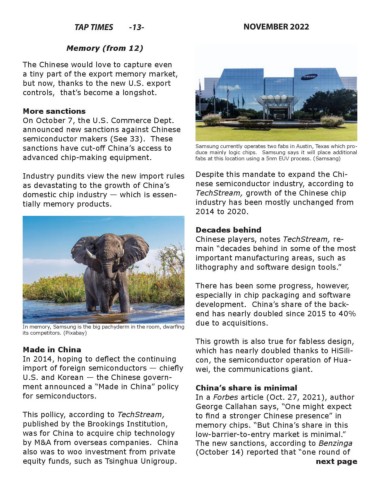
        In memory, Samsung is the big pachyderm in the room, dwarfing
        its competitors. (Pixabay)
                                                                This growth is also true for fabless design,
        Made in China                                           which has nearly doubled thanks to HiSili-
        In 2014, hoping to deflect the continuing               con, the semiconductor operation of Hua-
        import of foreign semiconductors — chiefly              wei, the communications giant.
        U.S. and Korean — the Chinese govern-
        ment announced a “Made in China” policy                 China’s share is minimal
        for semiconductors.                                     In a Forbes article (Oct. 27, 2021), author
                                                                George Callahan says, “One might expect
        This pollicy, according to TechStream,                  to find a stronger Chinese presence” in
        published by the Brookings Institution,                 memory chips. “But China’s share in this
        was for China to acquire chip technology                low-barrier-to-entry market is minimal.”
        by M&A from overseas companies.  China                  The new sanctions, according to Benzinga
        also was to woo investment from private                 (October 14) reported that “one round of
        equity funds, such as Tsinghua Unigroup.                                                              next page

