


Page 34 - foxconn preview june 25 051825_1340 hours.indd
P. 34
TAP TIMES          -34-                                     JUNE 2025

             Local automation becomes a tariff storm safe haven, but costly


        TAIPEI, Taiwan — TrendForce’s                           manufacturers — especially those
        latest “Human-Machine Technology                        in critical sectors like automotive,
        Report” points out that although the                    semiconductors, and electronics with
        90-day delay on the U.S. reciprocal                     U.S. or Mexico-based operations — to
        tariffs announced by the Trump                          adopt smart manufacturing and advanced
        administration in early April 2025                      automation at a faster pace.
        offer temporary relief, it has already
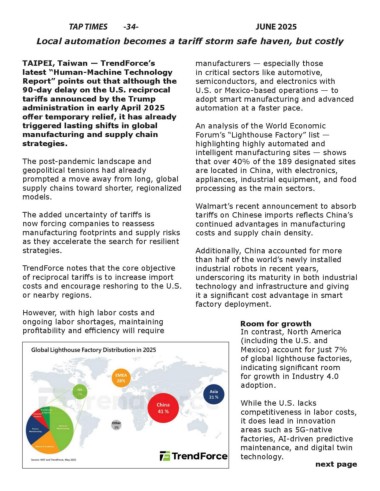
        triggered lasting shifts in global                      An analysis of the World Economic
        manufacturing and supply chain                          Forum’s “Lighthouse Factory” list —
        strategies.                                             highlighting highly automated and
                                                                intelligent manufacturing sites — shows
        The post-pandemic landscape and                         that over 40% of the 189 designated sites
        geopolitical tensions had already                       are located in China, with electronics,
        prompted a move away from long, global                  appliances, industrial equipment, and food
        supply chains toward shorter, regionalized              processing as the main sectors.
        models.
                                                                Walmart’s recent announcement to absorb
        The added uncertainty of tariffs is                     tariffs on Chinese imports reflects China’s
        now forcing companies to reassess                       continued advantages in manufacturing
        manufacturing footprints and supply risks               costs and supply chain density.
        as they accelerate the search for resilient
        strategies.                                             Additionally, China accounted for more
                                                                than half of the world’s newly installed
        TrendForce notes that the core objective                industrial robots in recent years,
        of reciprocal tariffs is to increase import             underscoring its maturity in both industrial
        costs and encourage reshoring to the U.S.               technology and infrastructure and giving
        or nearby regions.                                      it a significant cost advantage in smart
                                                                factory deployment.
        However, with high labor costs and
        ongoing labor shortages, maintaining                                  Room for growth
        profitability and efficiency will require                              In contrast, North America
                                                                               (including the U.S. and
                                                                               Mexico) account for just 7%
                                                                               of global lighthouse factories,
                                                                               indicating significant room
                                                                               for growth in Industry 4.0
                                                                               adoption.

                                                                               While the U.S. lacks
                                                                               competitiveness in labor costs,
                                                                               it does lead in innovation
                                                                               areas such as 5G-native
                                                                               factories, AI-driven predictive
                                                                               maintenance, and digital twin
                                                                               technology.
                                                                                                            next page

