


Page 30 - foxconn preview june 25 051825_1340 hours.indd
P. 30
TAP TIMES       -30-                                       JUNE 2025

           QD-OLED to account for 73% of OLED monitor shipments in 2025


        TAIPEI, Taiwan  — TrendForce’s latest                   TrendForce notes that the main advantage
        investigations reveal that ongoing                      of QD-OLED lies in its use of blue OLED
        advancements in OLED displays are                       light to excite quantum dots, which then
        propelling the growth of QD-OLED                        emit pure red and green light.
        monitor shipments.
                                                                This design boosts brightness, color
        QD-OLED’s share of OLED monitor                         saturation, and gamut coverage, resulting
        shipments is expected to rise from 68%                  in brighter, more vibrant, and finely
        in 2024 to 73% in 2025, highlighting its                detailed visuals.
        strong competitiveness in the high-end
        monitor market.                                         However, QD-OLED’s reliance on blue light
                                                                can impact panel longevity, and residual
        Driven by growing market demand, more                   ambient light in dark scenes may still
        brands and product lines are expected to                trigger unwanted quantum dot emissions
        adopt QD-OLED to deliver superior image                 in dark scenes, potentially compromising
        quality and refresh rates for gamers and                visual clarity.
        professional users.
                                                                Recent developments include the addition
        The introduction of new 27-inch UHD                     of a green emission layer, boosting
        products and high-refresh-rate QHD 500                  luminous efficiency by 30% to improve
        Hz monitors is drawing attention. These                 both energy consumption and image
        models offer strong appeal for gaming and               quality.
        professional use, becoming key drivers of               Pico inkjets
        QD-OLED monitor adoption.                               Meanwhile, PICO inkjets allow for more
                                                                precise deposition of quantum dot ink,
        The penetration rate of QD-OLED in 27-                  achieving pixel densities of 140 PPI
        inch models is projected to grow from                   and enabling 4K resolution on 32-inch
        32% in 2024 to 47% in 2025, driven by                   panels—further improving QD-OLED’s
        an expanding product lineup and ongoing                 competitiveness in the premium monitor
        technical improvements.                                 space.


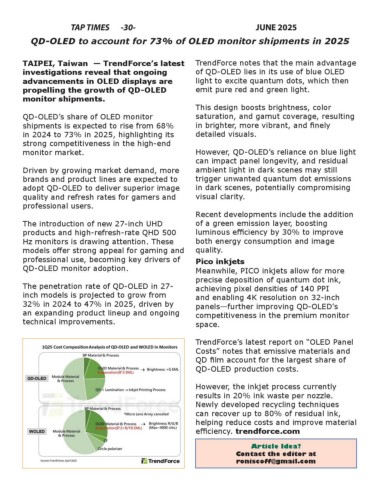
                                                                TrendForce’s latest report on “OLED Panel
                                                                Costs” notes that emissive materials and
                                                                QD film account for the largest share of
                                                                QD-OLED production costs.


                                                                However, the inkjet process currently
                                                                results in 20% ink waste per nozzle.
                                                                Newly developed recycling techniques
                                                                can recover up to 80% of residual ink,
                                                                helping reduce costs and improve material
                                                                efficiency. trendforce.com

                                                                                  Article Idea?
                                                                             Contact the editor at
                                                                             roniscoff@gmail.com

