


Page 15 - january23_122922.indd
P. 15
TAP TIMES          -15-


                    SIA report (from 14)                        technical standards, enhanced national
                                                                security, and created spill-over benefi ts for
        autonomous vehicles. The U.S. has built-in              adjacent industries.
        advantages in chip design, including being
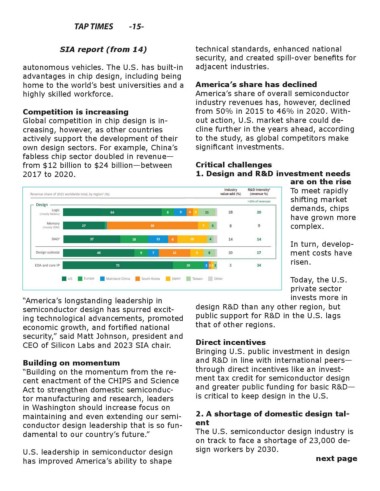
        home to the world’s best universities and a             America’s share has declined
        highly skilled workforce.                               America’s share of overall semiconductor
                                                                industry revenues has, however, declined
        Competition is increasing                               from 50% in 2015 to 46% in 2020. With-
        Global competition in chip design is in-                out action, U.S. market share could de-
        creasing, however, as other countries                   cline further in the years ahead, according
        actively support the development of their               to the study, as global competitors make
        own design sectors. For example, China’s                signifi cant investments.
        fabless chip sector doubled in revenue—
        from $12 billion to $24 billion—between                 Critical challenges
        2017 to 2020.                                           1. Design and R&D investment needs
                                                                                               are on the rise
                                                                                               To meet rapidly
                                                                                               shifting market
                                                                                               demands, chips
                                                                                               have grown more
                                                                                               complex.

                                                                                               In turn, develop-
                                                                                               ment costs have
                                                                                               risen.

                                                                                               Today, the U.S.
                                                                                               private sector

        “America’s longstanding leadership in                                                  invests more in
        semiconductor design has spurred excit-                 design R&D than any other region, but
        ing technological advancements, promoted                public support for R&D in the U.S. lags
        economic growth, and fortifi ed national                that of other regions.
        security,” said Matt Johnson, president and
        CEO of Silicon Labs and 2023 SIA chair.                 Direct incentives
                                                                Bringing U.S. public investment in design
        Building on momentum                                    and R&D in line with international peers—
        “Building on the momentum from the re-                  through direct incentives like an invest-
        cent enactment of the CHIPS and Science                 ment tax credit for semiconductor design
        Act to strengthen domestic semiconduc-                  and greater public funding for basic R&D—
        tor manufacturing and research, leaders                 is critical to keep design in the U.S.
        in Washington should increase focus on
        maintaining and even extending our semi-                2. A shortage of domestic design tal-
        conductor design leadership that is so fun-             ent
        damental to our country’s future.”                      The U.S. semiconductor design industry is
                                                                on track to face a shortage of 23,000 de-
        U.S. leadership in semiconductor design                 sign workers by 2030.
        has improved America’s ability to shape                                                        next page

