


Page 47 - february_012822.indd
P. 47
TAP TIMES          -47-                                 FEBRUARY 2022


          Semiconductor leadership (from 45)                    institutions face an uphill battle as more
                                                                students abandon “hard tech” for fields
        investments have boosted their domes-                   like computer science. Attracting more
        tic microchip companies and even enticed                students will require exciting hands-on lab
        some U.S. firms to open fabrication facili-             courses, inspiring research experiences,
        ties overseas, del Alamo explains.                      well-crafted internships, and support from
                                                                industry mentors, as well as fellowships at
        A chip manufacturing plant, also known as               all levels, among many other initiatives.
        a fab, might cost as much as $10 billion,
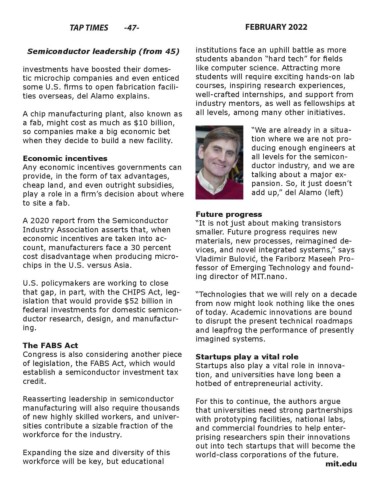
        so companies make a big economic bet                                      “We are already in a situa-
        when they decide to build a new facility.                                 tion where we are not pro-
                                                                                  ducing enough engineers at
        Economic incentives                                                       all levels for the semicon-
        Any economic incentives governments can                                   ductor industry, and we are
        provide, in the form of tax advantages,                                   talking about a major ex-
        cheap land, and even outright subsidies,                                  pansion. So, it just doesn’t
        play a role in a firm’s decision about where                              add up,” del Alamo (left)
        to site a fab.
                                                                Future progress
        A 2020 report from the Semiconductor                    “It is not just about making transistors
        Industry Association asserts that, when                 smaller. Future progress requires new
        economic incentives are taken into ac-                  materials, new processes, reimagined de-
        count, manufacturers face a 30 percent                  vices, and novel integrated systems,” says
        cost disadvantage when producing micro-                 Vladimir Bulović, the Fariborz Maseeh Pro-
        chips in the U.S. versus Asia.                          fessor of Emerging Technology and found-

                                                                ing director of MIT.nano.
        U.S. policymakers are working to close
        that gap, in part, with the CHIPS Act, leg-             “Technologies that we will rely on a decade
        islation that would provide $52 billion in              from now might look nothing like the ones
        federal investments for domestic semicon-               of today. Academic innovations are bound
        ductor research, design, and manufactur-                to disrupt the present technical roadmaps
        ing.                                                    and leapfrog the performance of presently
                                                                imagined systems.
        The FABS Act
        Congress is also considering another piece              Startups play a vital role
        of legislation, the FABS Act, which would               Startups also play a vital role in innova-
        establish a semiconductor investment tax                tion, and universities have long been a
        credit.                                                 hotbed of entrepreneurial activity.


        Reasserting leadership in semiconductor                 For this to continue, the authors argue
        manufacturing will also require thousands               that universities need strong partnerships
        of new highly skilled workers, and univer-              with prototyping facilities, national labs,
        sities contribute a sizable fraction of the             and commercial foundries to help enter-
        workforce for the industry.                             prising researchers spin their innovations
                                                                out into tech startups that will become the
        Expanding the size and diversity of this                world-class corporations of the future.
        workforce will be key, but educational                                                            mit.edu

