


Page 38 - february_012822.indd
P. 38
TAP TIMES          -38-                             FEBRUARY 2022


           New MIT process may lessen                           recycling, and rare-earth separation,” says
             rare earth metals’ shortage                        Stinn. “Those are processes that make
                                                                materials for sustainability applications,

        CAMBRIDGE, Mass. — New processing                       but the processes themselves are very
        methods developed by MIT research-                      unsustainable.”
        ers could help ease looming shortages
        of the essential metals that power                      Growing demand
        everything from phones to automotive                    The findings offer one way to alleviate a
        batteries, by making it easier to sepa-                 growing demand for minor metals like co-
        rate these rare metals from mining                      balt, lithium, and rare earth elements that
        ores and recycled materials.                            are used in “clean” energy products like
                                                                electric cars, solar cells, and electricity-
        Selective adjustments                                   generating windmills.
        Selective adjustments within a chemical
        process called sulfidation allowed profes-
        sor of metallurgy Antoine Allanore and his
        graduate student Caspar Stinn to success-
        fully target and separate rare metals, such
        as the cobalt in a lithium-ion battery, from
        mixed-metal materials.


        As they report in Nature, their processing
        techniques allow the metals to remain in
        solid form and be separated without dis-
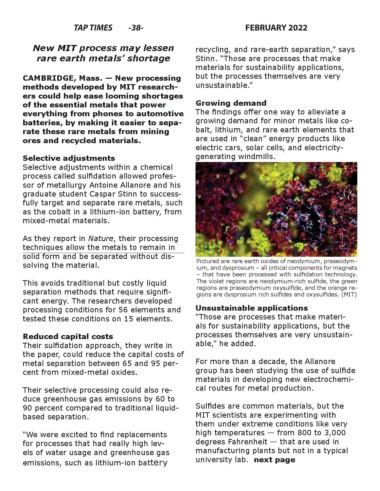
        solving the material.                                   Pictured are rare earth oxides of neodymium, praseodym-
                                                                ium, and dysprosium – all critical components for magnets
                                                                – that have been processed with sulfidation technology.
        This avoids traditional but costly liquid               The violet regions are neodymium-rich sulfide, the green
        separation methods that require signifi-                regions are praseodymium oxysulfide, and the orange re-
                                                                gions are dysprosium rich sulfides and oxysulfides. (MIT)
        cant energy. The researchers developed
        processing conditions for 56 elements and               Unsustainable applications
        tested these conditions on 15 elements.                 “Those are processes that make materi-
                                                                als for sustainability applications, but the
        Reduced capital costs                                   processes themselves are very unsustain-
        Their sulfidation approach, they write in               able,” he added.
        the paper, could reduce the capital costs of
        metal separation between 65 and 95 per-                 For more than a decade, the Allanore
        cent from mixed-metal oxides.                           group has been studying the use of sulfide
                                                                materials in developing new electrochemi-
        Their selective processing could also re-               cal routes for metal production.
        duce greenhouse gas emissions by 60 to
        90 percent compared to traditional liquid-              Sulfides are common materials, but the
        based separation.                                       MIT scientists are experimenting with
                                                                them under extreme conditions like very

        “We were excited to find replacements                   high temperatures — from 800 to 3,000
        for processes that had really high lev-                 degrees Fahrenheit — that are used in
        els of water usage and greenhouse gas                   manufacturing plants but not in a typical
        emissions, such as lithium-ion battery                  university lab.  next page

