


Page 31 - february_012822.indd
P. 31
TAP TIMES       -31-                               FEBRUARY 2022


             Technique boosts graphene                          (Berkeley Lab) and UC Berkeley have de-
                 nanoribbons’ potential                         veloped a method to stabilize the edges of
                                                                graphene nanoribbons and directly mea-
        BERKELEY, Calif. — Ever since gra-                      sure their unique magnetic properties.
        phene – a thin carbon sheet just one-
        atom thick – was discovered more                        Carbon atoms substitution
        than 15 years ago, the wonder mate-                     The team co-led by Felix Fischer and
        rial became a workhorse in materials                    Steven Louie, both faculty scientists in
        science research.                                       Berkeley Lab’s Materials Sciences Division,
                                                                found that by substituting some of the car-
        Exotic magnetic properties                              bon atoms along the ribbon’s zigzag edges
        From this body of work, other research-                 with nitrogen atoms, they could discretely
        ers learned that slicing graphene along                 tune the local electronic structure without
        the edge of its honeycomb lattice creates               disrupting the magnetic properties.
        one-dimensional zigzag graphene strips or
        nanoribbons with exotic magnetic proper-                This subtle structural change further en-
        ties.                                                   abled the development of a scanning
                                                                probe microscopy technique for measur-
        Many researchers have sought to harness                 ing the material’s local magnetism at the
        nanoribbons’ unusual magnetic behavior                  atomic scale.
        into carbon-based, spintronics devices that
        enable high-speed, low-power data stor-                 “Prior attempts to stabilize the zigzag edge
        age and information processing technolo-                inevitably altered the electronic structure
        gies by encoding data through electron                  of the edge itself,” said Louie, who is also a
        spin instead of charge.                                 professor of physics at UC Berkeley.

                                                                “This dilemma has doomed eff orts to ac-
                                                                cess their magnetic structure with ex-
                                                                perimental techniques, and until now rel-
                                                                egated their exploration to computational
                                                                models,” he added.

                                                                Guidance from theoretical models
                                                                Guided by theoretical models, Fischer and
                                                                Louie designed a custom-made molecular
                                                                building block featuring an arrangement
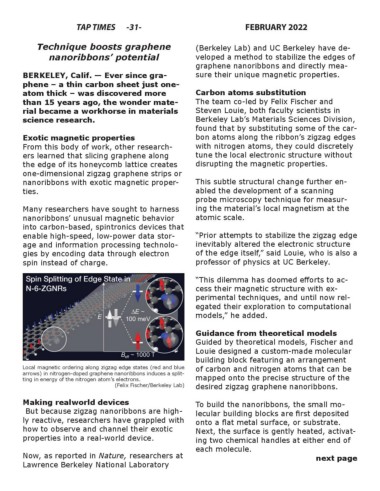
        Local magnetic ordering along zigzag edge states (red and blue   of carbon and nitrogen atoms that can be
        arrows) in nitrogen-doped graphene nanoribbons induces a split-
        ting in energy of the nitrogen atom’s electrons.        mapped onto the precise structure of the
                                      (Felix Fischer/Berkeley Lab)  desired zigzag graphene nanoribbons.

        Making realworld devices                                To build the nanoribbons, the small mo-
         But because zigzag nanoribbons are high-               lecular building blocks are fi rst deposited
        ly reactive, researchers have grappled with             onto a fl at metal surface, or substrate.
        how to observe and channel their exotic                 Next, the surface is gently heated, activat-
        properties into a real-world device.                    ing two chemical handles at either end of

                                                                each molecule.
        Now, as reported in Nature, researchers at                                                     next page
        Lawrence Berkeley National Laboratory

