


Page 28 - august_072922.indd
P. 28
TAP TIMES       -28-                                      AUGUST 2022


                   Smart Socks (from 27)

        To produce a smart textile, the researchers
        use a digital knitting machine that weaves
        together standard and functional yarn.


        Multi-layer knit
        The multilayer knit textile is composed of
        two layers of conductive yarn knit sand-
        wiched around a piezoresistive knit, which
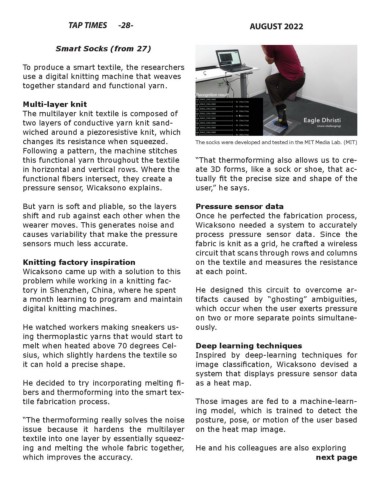
        changes its resistance when squeezed.                   The socks were developed and tested in the MIT Media Lab. (MIT)
        Following a pattern, the machine stitches
        this functional yarn throughout the textile             “That thermoforming also allows us to cre-
        in horizontal and vertical rows. Where the              ate 3D forms, like a sock or shoe, that ac-
        functional fibers intersect, they create a              tually fit the precise size and shape of the
        pressure sensor, Wicaksono explains.                    user,” he says.


        But yarn is soft and pliable, so the layers             Pressure sensor data
        shift and rub against each other when the               Once he perfected the fabrication process,
        wearer moves. This generates noise and                  Wicaksono needed a system to accurately
        causes variability that make the pressure               process  pressure  sensor  data.  Since  the
        sensors much less accurate.                             fabric is knit as a grid, he crafted a wireless
                                                                circuit that scans through rows and columns
        Knitting factory inspiration                            on the textile and measures the resistance
        Wicaksono came up with a solution to this               at each point.
        problem while working in a knitting fac-
        tory in Shenzhen, China, where he spent                 He  designed  this  circuit to  overcome  ar-
        a month learning to program and maintain                tifacts  caused  by  “ghosting” ambiguities,
        digital knitting machines.                              which occur when the user exerts pressure
                                                                on two or more separate points simultane-
        He watched workers making sneakers us-                  ously.
        ing thermoplastic yarns that would start to
        melt when heated above 70 degrees Cel-                  Deep learning techniques
        sius, which slightly hardens the textile so             Inspired  by deep-learning  techniques  for
        it can hold a precise shape.                            image  classification,  Wicaksono  devised  a
                                                                system that displays pressure sensor data
        He decided to try incorporating melting fi-             as a heat map.
        bers and thermoforming into the smart tex-
        tile fabrication process.                               Those images are fed to a machine-learn-
                                                                ing model,  which is trained  to  detect  the
        “The thermoforming really solves the noise              posture, pose, or motion of the user based
        issue  because  it  hardens  the  multilayer            on the heat map image.
        textile into one layer by essentially squeez-
        ing and melting the whole fabric together,              He and his colleagues are also exploring
        which improves the accuracy.                                                                   next page

