


Page 3 - december22_112922.indd
P. 3
December 2022
                  TAP TIMES                          TM                      Volume 13, Number 11


                 The new China Syndrome: a tale of two countries


                        s we noted in our Novem-
                        ber issue, the Friday, Oc-
                        tober 7 sanctions against
                        China are a day that — to
                        borrow President Frank-
                        lin D. Roosevelt’s famous
       Awords — will live in in-
                        famy — at least for the
                        semiconductor industry.


                       Ron Iscoff, Editor
                      roniscoff@gmail.com


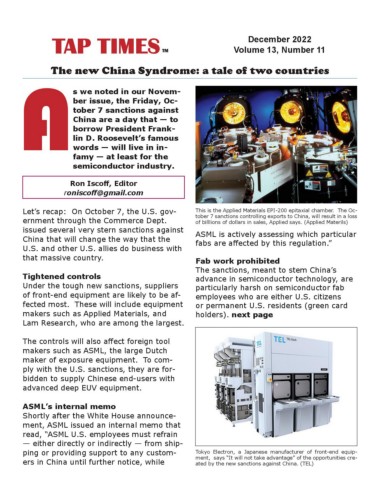
        Let’s recap:  On October 7, the U.S. gov-               This is the Applied Materials EPI-200 epitaxial chamber.  The Oc-
        ernment through the Commerce Dept.                      tober 7 sanctions controlling exports to China, will result in a loss
                                                                of billlions of dollars in sales, Applied says. (Applied Materils)
        issued several very stern sanctions against             ASML is actively assessing which particular
        China that will change the way that the                 fabs are affected by this regulation.”
        U.S. and other U.S. allies do business with
        that massive country.                                   Fab work prohibited
                                                                The sanctions, meant to stem China’s
        Tightened controls                                      advance in semiconductor technology, are
        Under the tough new sanctions, suppliers                particularly harsh on semiconductor fab
        of front-end equipment are likely to be af-             employees who are either U.S. citizens
        fected most.  These will include equipment              or permanent U.S. residents (green card
        makers such as Applied Materials, and                   holders). next page
        Lam Research, who are among the largest.


        The controls will also affect foreign tool
        makers such as ASML, the large Dutch
        maker of exposure equipment.  To com-
        ply with the U.S. sanctions, they are for-
        bidden to supply Chinese end-users with
        advanced deep EUV equipment.


        ASML’s internal memo
        Shortly after the White House announce-
        ment, ASML issued an internal memo that
        read, “ASML U.S. employees must refrain
        — either directly or indirectly — from ship-
        ping or providing support to any custom-                Tokyo Electron,  a  Japanese  manufacturer  of  front-end  equip-
        ers in China until further notice, while                ment,  says “It will not take advantage” of the opportunities cre-
                                                                ated by the new sanctions against China. (TEL)

